Mercedes-Benz: The Legacy of Innovation and Elegance
The story of Mercedes-Benz begins with a spark of imagination in the late 19th century. In a small German workshop, Karl Benz tinkered with an engine that could replace the horse-drawn carriage. In 1886, he unveiled the Benz Patent-Motorwagen, a three-wheeled vehicle powered by a single-cylinder internal combustion engine. It wasn’t just a machine—it was a revolution on wheels. Meanwhile, in another workshop, Gottlieb Daimler and his partner Wilhelm Maybach were developing high-speed engines, pushing the boundaries of what machines could do. Neither could have imagined that their separate dreams would one day converge into one of the most iconic names in automotive history.
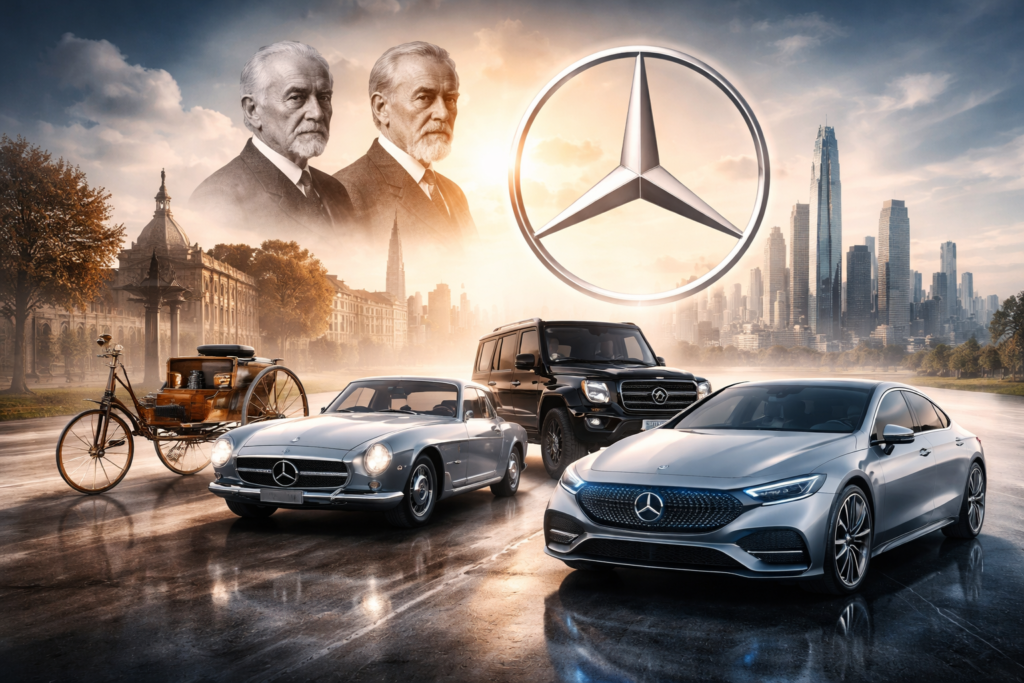 That convergence happened in 1926, when Benz & Cie. merged with Daimler-Motoren-Gesellschaft, creating Mercedes-Benz. The name “Mercedes” came from Mercedes Jellinek, the spirited daughter of businessman Emil Jellinek, whose vision and influence helped shape the early DMG cars. Mercedes-Benz immediately set itself apart—luxury, precision, and innovation were built into every vehicle. These cars weren’t just modes of transport; they were statements of engineering artistry.
By the 1930s, Mercedes-Benz was dominating Grand Prix racing, thrilling crowds with cars like the Silver Arrows, which were so fast and elegant that they seemed to fly across the track. Engineers experimented with aerodynamics and supercharged engines, blending performance with style. Even in the glamorous salons of Europe, a Mercedes-Benz stood as a mark of taste, status, and technical brilliance.
The war years brought challenges, but Mercedes-Benz emerged resilient. In the 1950s, it captured the world’s imagination again with the legendary 300 SL Gullwing, its upward-swinging doors becoming an instant icon. Drivers and celebrities alike marveled at its combination of speed and sophistication. The car wasn’t just transportation; it was art, a symbol of post-war optimism and human ingenuity. Around the same time, the S-Class set new benchmarks for luxury and innovation, integrating comfort, safety, and engineering that felt almost futuristic. Toyota Motor Corporation History: From 1937 Founding to Iconic Car Models Worldwide
Mercedes-Benz continued to lead in safety and technology through the 1970s to 1990s. It pioneered anti-lock brakes, airbags, crumple zones, and traction control—features that saved countless lives and redefined what drivers could expect from a car. The G-Class SUV, initially designed for rugged military use, became a lifestyle symbol, embodying adventure and refinement. Every model told a story, blending tradition with forward-thinking design.
As the world entered the 21st century, Mercedes-Benz embraced a new era. The brand invested heavily in electric vehicles and sustainable mobility, unveiling the EQ series, including the futuristic EQS that combined luxury with zero emissions. Autonomous driving, AI-assisted safety, and connected technology redefined what it meant to drive. And yet, through all this innovation, Mercedes-Benz retained its soul—elegance, performance, and uncompromising quality.
Disclaimer:
The content on this blog is for informational and educational purposes only. The views and opinions expressed here are those of the author and do not constitute professional advice. While we strive for accuracy, we make no guarantees regarding the completeness, reliability, or suitability of the information. Readers should use their own judgment and, if necessary, consult a qualified professional before making any decisions based on the content of this blog.