The Evolution of Hyundai Motor Company
From Budget Cars to Affordable, Reliable, and Premium Mobility
Hyundai Motor Company is one of the most remarkable success stories in the global automobile industry. What began as a small South Korean car manufacturer in the 1960s has evolved into one of the world’s largest automotive companies, known for producing affordable, reliable, and increasingly premium vehicles. Today, Hyundai competes with global giants by combining innovation, modern design, and exceptional value.
Over the decades, Hyundai has continuously invested in research and development, improving engineering quality, safety standards, and customer satisfaction. Its global expansion into markets like North America, Europe, and India has helped the brand establish a strong international presence. Hyundai’s focus on sustainability, electric mobility, and futuristic technologies positions it as a forward-looking leader in the evolving automotive landscape.
1. The Early Years (1967–1980s): Foundations of a Korean Automaker
Hyundai Motor Company was founded in 1967 in Seoul, South Korea as part of the larger Hyundai conglomerate. Initially, the company assembled vehicles under license from foreign manufacturers.
One of Hyundai’s earliest milestones was the production of the Hyundai Pony in 1975, the first mass-produced car designed and built in South Korea. This model marked the beginning of Hyundai’s ambition to develop indigenous automotive technology.
During the late 1970s and 1980s, Hyundai began exporting vehicles to international markets. A major breakthrough came in 1986, when Hyundai entered the United States with the Hyundai Excel, an inexpensive compact car that quickly gained popularity due to its low price and practicality.
However, early Hyundai models faced criticism for quality issues, which prompted the company to focus heavily on improving engineering and reliability.
2. Technological Independence and Growth (1990s)
The 1990s were a crucial decade for Hyundai’s transformation. The company invested significantly in research and development to reduce dependence on foreign technology.
Key achievements included:
- Development of Hyundai’s first proprietary engine (Alpha engine) in 1991
- Creation of its own transmission systems
- Rapid expansion of global production capacity
Hyundai also expanded internationally by establishing manufacturing facilities in new markets. One of the most important was the Hyundai Motor India plant near Chennai in 1996, which later became a major export hub for compact cars.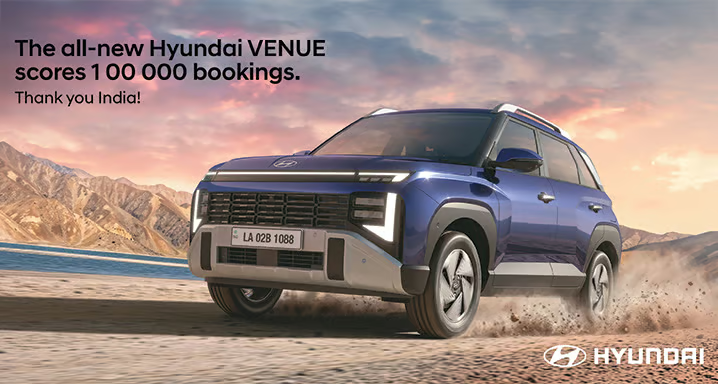
Another landmark event occurred in 1998, when Hyundai acquired a majority stake in Kia Corporation during the Asian financial crisis. This acquisition helped Hyundai strengthen its global market position and form the powerful Hyundai Motor Group.
3. Global Expansion and Product Diversification (2000–2010)
Entering the 21st century, Hyundai focused on building a reputation for quality, safety, and reliability.
Major developments during this era included:
-
Launch of popular global models like the Sonata, Elantra, and Santa Fe
-
Introduction of long warranties to build customer trust
-
Expansion into Europe, North America, and emerging markets
-
Development of advanced engines and fuel technologies
Hyundai also invested heavily in design and innovation. By the mid-2000s, the company had built modern R&D centers worldwide and improved manufacturing standards.
This period marked Hyundai’s shift from being seen as a cheap car brand to a value-for-money global competitor.
4. Design Revolution and Brand Transformation (2010–2020)
During the 2010s, Hyundai dramatically transformed its brand image. The company introduced its “Fluidic Sculpture” design philosophy, giving its vehicles a bold and modern look.
Key developments included:
-
Launch of stylish vehicles such as the Hyundai i30, Tucson, and Creta
-
Expansion of SUVs and crossover vehicles
-
Establishment of the Genesis luxury brand in 2015
-
Rapid growth in global sales and market presence
Hyundai also began exploring electric, hybrid, and fuel-cell vehicles, demonstrating its commitment to sustainable mobility. Early experiments with electric vehicles date back to the 1990s, but commercial development accelerated during this decade.
By the late 2010s, Hyundai had become one of the largest automakers in the world.
5. Electric Mobility and Future Technologies (2020–Present)
In the 2020s, Hyundai began transitioning from a traditional automaker to a mobility solutions provider.
Key innovations include:
-
Launch of the IONIQ electric vehicle lineup, starting with the IONIQ 5 in 2021
-
Investments in autonomous driving and robotics
-
Development of hydrogen fuel-cell technology
-
Partnerships for EV battery manufacturing and clean energy solutions
Hyundai has also committed to achieving carbon neutrality by 2045, highlighting its focus on sustainable mobility.
The company continues to invest heavily in future technologies and manufacturing. Recent initiatives include building hydrogen fuel-cell facilities and expanding research and development for electric mobility.
6. Hyundai in India: A Key Global Market
India is one of Hyundai’s most important markets. Since entering the country in 1996, Hyundai has become one of the leading car manufacturers in India.
The company’s Chennai facility serves as a major export hub, shipping vehicles to dozens of countries worldwide.
Popular Hyundai models in India include:
Hyundai continues to invest billions in India to develop new vehicles, expand production capacity, and introduce electric models.
7. Hyundai Today: Affordable, Reliable, and Premium
Today, Hyundai has successfully transformed its identity.
The brand now represents:
-
Affordability: Competitive pricing across many markets
-
Reliability: Improved engineering and strong warranties
-
Premium appeal: Advanced design, luxury features, and the Genesis brand
With operations in over 190 countries and millions of vehicles sold annually, Hyundai has become a global automotive powerhouse.
✅ Conclusion
The evolution of Hyundai Motor Company reflects a journey from a small Korean manufacturer to a global mobility leader. Through continuous innovation, technological development, and strategic expansion, Hyundai has reshaped its brand image from producing inexpensive cars to delivering high-quality, technologically advanced, and increasingly premium vehicles.
As the automotive industry moves toward electrification, automation, and sustainable mobility, Hyundai is positioning itself at the forefront of the next generation of transportation.
Disclaimer:
The content on this blog is for informational and educational purposes only. The views and opinions expressed here are those of the author and do not constitute professional advice. While we strive for accuracy, we make no guarantees regarding the completeness, reliability, or suitability of the information. Readers should use their own judgment and, if necessary, consult a qualified professional before making any decisions based on the content of this blog.