The story of the Ford Motor Company is more than just the history of a car manufacturer; it’s the story of industrial innovation, mass production, and the democratization of mobility. From its humble beginnings in Detroit to becoming a global automotive powerhouse, Ford has continually reshaped the landscape of transportation.

1. The Early Years: A Vision for Affordable Cars
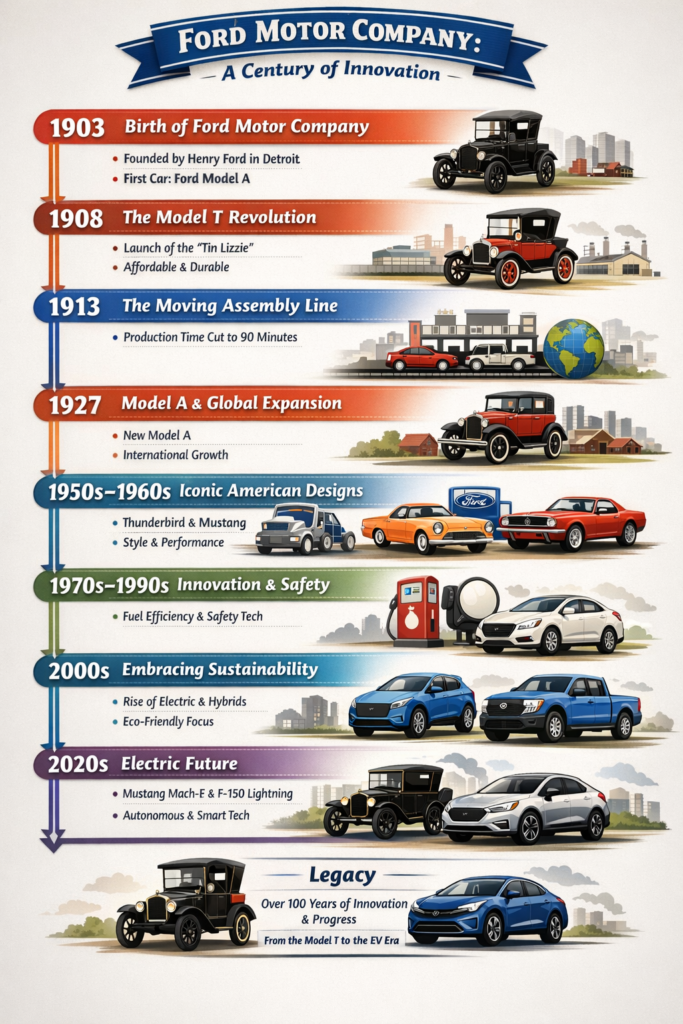
Founded in 1903 by Henry Ford in Detroit, Michigan, the Ford Motor Company set out with a revolutionary vision: to produce automobiles that were affordable and reliable for the average American. The company’s first vehicle, the Ford Model A, launched in 1903, marked the beginning of Ford’s mission to make cars accessible beyond the wealthy elite.
However, it was the introduction of the Model T in 1908 that truly transformed the automotive industry. Dubbed the “Tin Lizzie,” the Model T was affordable, durable, and easy to maintain, quickly becoming a symbol of personal freedom and mobility in America.
2. Revolutionizing Production: The Assembly Line
One of Ford’s most significant contributions to industry wasn’t a car—it was a manufacturing innovation. In 1913, Henry Ford implemented the moving assembly line, a method that drastically reduced production time for a single vehicle from over 12 hours to just 90 minutes. This innovation lowered costs and allowed Ford to offer the Model T at an unprecedented price, making car ownership a reality for millions.
3. Growth and Diversification
Through the 1920s and 1930s, Ford expanded both domestically and internationally. The company diversified its offerings with new models like the Model A (1927), catering to changing consumer tastes. Ford also established plants abroad, laying the groundwork for its future as a global automaker.
Despite the challenges of the Great Depression, Ford survived by focusing on efficiency, quality, and innovation, a testament to its resilience and forward-thinking leadership.
4. Post-War Expansion and Innovation
After World War II, Ford emerged as a leader in automotive design and technology. The company introduced iconic vehicles such as the Ford Thunderbird (1955) and the Ford Mustang (1964), which combined style, performance, and affordability, capturing the imagination of a new generation of drivers.
During this period, Ford also embraced innovations in safety, comfort, and fuel efficiency, positioning itself as a brand that balanced performance with practicality.
5. Modern Era: Sustainability and Technology
In the 21st century, Ford has shifted its focus toward sustainability and technology. The company has invested heavily in electric vehicles (EVs) and autonomous driving technologies, signaling its commitment to the future of transportation. Models like the Ford Mustang Mach-E and the Ford F-150 Lightning showcase Ford’s adaptation to changing consumer demands and environmental considerations.
Ford has also embraced global markets, integrating advanced manufacturing techniques and digital technologies to remain competitive in an increasingly complex automotive landscape.
6. Legacy and Impact
Today, the Ford Motor Company stands as a symbol of innovation, resilience, and accessibility in the automotive world. From pioneering mass production to leading the charge in electric mobility, Ford has continually evolved to meet the needs of its customers while shaping the industry as a whole.
Ford’s journey is a testament to how visionary leadership, commitment to innovation, and adaptability can transform a small company into a global icon.
Ford continues to drive forward, proving that even after more than a century, the spirit of innovation that Henry Ford instilled in 1903 is very much alive. The company’s ongoing evolution promises exciting developments in mobility, technology, and sustainability for generations to come.
Disclaimer:
The content on this blog is for informational and educational purposes only. The views and opinions expressed here are those of the author and do not constitute professional advice. While we strive for accuracy, we make no guarantees regarding the completeness, reliability, or suitability of the information. Readers should use their own judgment and, if necessary, consult a qualified professional before making any decisions based on the content of this blog.