The ‘Open Claw’ Moment: How a Split-Second Gesture Lit Up the AI Cold War
On February 19, 2026, at the India AI Impact Summit in New Delhi, what was meant to be a symbolic moment of unity turned into the internet’s favorite metaphor for the AI industry’s most closely watched rivalry.
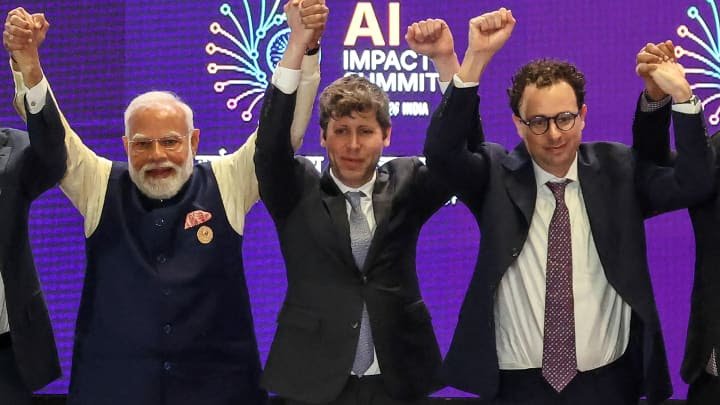
At the center of it all were Sam Altman, CEO of OpenAI, and Dario Amodei, CEO of Anthropic. And then came the lobster claws.
A Stage, A Gesture, A Pause
During the summit, Indian Prime Minister Narendra Modi attempted to orchestrate a classic unity photo-op: leaders holding hands and raising them together to signal collaboration.
On one side stood Sundar Pichai. On the other, Sam Altman. Most participants linked hands smoothly. But in the middle stood Altman and Amodei. Instead of joining hands, both men raised clenched fists separately. No clasp. No symbolic link. No eye contact. Just two AI titans staring forward. Within minutes, the clip went viral.
Headlines dubbed it:
- “An AI Cold War on Stage”
- “A Symbolic Snub”
- “The Most Expensive Awkward Moment in Tech”
Altman later dismissed the moment as confusion. “I didn’t know what was happening,” he told reporters. “Modi grabbed my hand and put it up, and I wasn’t sure what we were supposed to be doing.”
Then someone joked: “I think it was an open claw.” And the internet ran with it. Enter the Lobster Claws Hours later, the ChatGPT app account posted a surreal image: Altman standing beside Modi — but with glowing red lobster claws instead of hands. One claw was tightly closed toward Modi. The other was slightly open toward Amodei.
- No caption.
- No explanation.
- Just claws.
Online, the symbolism exploded:
- “You can’t hold hands if you have claws.”
- “OpenClaw vs Claude.”
- “Claws don’t cooperate. They compete.”
In internet culture, lobsters and claws signal defensiveness, tension, aggression — even territorial behavior. Whether intentional or playful, the imagery struck a nerve. Because beneath the humor lies a very real rivalry. From Colleagues to Competitors Dario Amodei isn’t just a rival CEO. He’s OpenAI alumni. Before founding Anthropic in 2021, Amodei served as OpenAI’s Vice President of Research. He led development on GPT-2 and GPT-3 — foundational models that propelled OpenAI into the global spotlight. In 2020, he left the company over strategic and philosophical differences. A year later, alongside his sister Daniela Amodei and several former OpenAI employees, he launched Anthropic — positioning it as a safety-first AI company with a more cautious scaling philosophy. In a 2024 podcast, Amodei explained his departure bluntly:
“It is incredibly unproductive to try and argue with someone else’s vision.”
That line now feels prophetic.
The Rivalry Goes Public. The tension isn’t just theoretical anymore. Earlier this year during the Super Bowl, Anthropic aired ads that subtly criticized OpenAI’s reported plans to introduce advertising into ChatGPT’s free tier. It was a rare moment of direct competitive signaling in an industry that typically couches rivalry in polite press releases.
What we’re seeing now isn’t just product competition — it’s ideological divergence:
OpenAI: Consumer scale, massive infrastructure investment, rapid iteration.
Anthropic: Enterprise focus, safety positioning, margin discipline.
The summit moment became viral because it visually condensed that divide.
Market Reality: David vs Goliath?
On the surface, OpenAI dominates. 800–900 million weekly active users. Estimated valuation: ~$500 billion. Heavy compute spending: ~$17 billion annually. Long-term ambition: A potential $1 trillion IPO by 2027. ChatGPT is the household name.
Anthropic, by contrast: ~20 million monthly consumer users. ~$380 billion valuation after a recent $30 billion raise. 32% enterprise AI market share (ahead of OpenAI’s ~25%). Projected break-even by 2028.
In consumer AI, OpenAI leads by scale. In enterprise AI, Anthropic is quietly winning contracts. So when the two CEOs stood side by side — hands not quite touching — it wasn’t just awkwardness. It was market tension in human form.
The PayPal Mafia Parallel
Tech history loves a founder diaspora story.
When eBay acquired PayPal in 2002, former executives like Peter Thiel, Elon Musk, and Reid Hoffman went on to build or fund giants like YouTube, LinkedIn, Tesla, Yelp, SpaceX, and Palantir.AI Impact Summit 2026: People, Planet और Progress के साथ Responsible AI Governance की ओर भारत का नेतृत्व
Now, OpenAI is experiencing its own version.
Anthropic is arguably the most powerful company ever founded by OpenAI alumni — and the first capable of challenging it at scale.
The AI ecosystem is still small. Many researchers studied under the same mentors. Many once shared the same labs.
Which makes the rivalry more Shakespearean than corporate. Why the ‘Open Claw’ Moment Resonated
The image worked because it tapped into three truths:
1. Cooperation and competition coexist
AI leaders collaborate on policy, safety, and global forums — while fiercely competing for talent and compute.
2. Symbolism matters in geopolitics
The summit wasn’t just a tech event. It was hosted by the Indian government, signaling AI as strategic infrastructure. Visual unity carries weight.
3. The AI race is becoming personal
When founders split over vision and then build rival empires, body language gets analyzed like political diplomacy.
Was It Really Intentional?
Maybe it was just confusion. Stage choreography can be chaotic. Cameras distort angles. Microseconds look meaningful in slow motion. But the lobster claws changed the narrative. The post signaled something playful — yet pointed. It turned a mundane stumble into myth.
The Bigger Picture
The AI race is no longer theoretical. It’s geopolitical, commercial, and deeply personal. OpenAI wants scale dominance. Anthropic wants enterprise durability. Governments want strategic leverage. Users want reliability and trust.
And on New Delhi stage, all of that compressed into a moment where two hands didn’t quite meet. Maybe it was confusion. Maybe it was coincidence. Or maybe, in the age of artificial intelligence, even a claw can tell a story.
Disclaimer:
The content on this blog is for informational and educational purposes only. The views and opinions expressed here are those of the author and do not constitute professional advice. While we strive for accuracy, we make no guarantees regarding the completeness, reliability, or suitability of the information. Readers should use their own judgment and, if necessary, consult a qualified professional before making any decisions based on the content of this blog.