Viral baby monkey, At the Ichikawa City Zoo and Botanical Garden
Japanese macaque named Punch clutches a stuffed orangutan as if it were a lifeline. In the videos that swept across social media this February, Viral baby monkey wanders his enclosure alone, dragging the plush toy behind him, chased off by older monkeys or shrinking into corners to hug it tight. What might have been a small, private struggle inside a zoo became a global meditation on emotion — both animal and human.
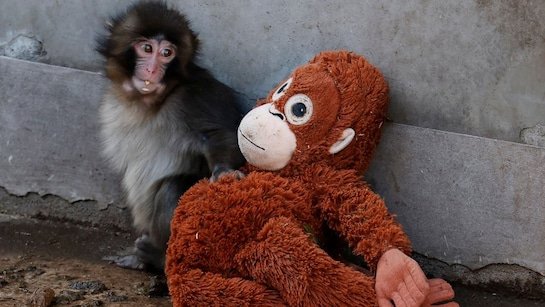
Punch’s story resonates because it exposes something raw: the ache of rejection. Among Japanese macaques, social bonds are everything. Grooming is currency. Touch is reassurance. Rank determines safety. A young macaque rejected by his mother and unable to integrate into the troop faces not only loneliness but biological stress. Studies of primates show that social isolation elevates cortisol levels and can impair development. Belonging is not sentimental; it is survival.
When zookeepers offered Punch a plush substitute, they were not simply indulging a cute image. They were responding to a well-documented behavioral truth: infant primates cling. The need for tactile comfort runs deep in mammals. Decades ago, psychologist Harry Harlow’s controversial experiments demonstrated that baby rhesus monkeys preferred soft surrogate “mothers” over wire ones that provided milk. Comfort, not just nutrition, sustains life.
Punch dragging his stuffed orangutan is not an act of fantasy. It is attachment behavior — the same instinct that drives human toddlers to carry blankets worn thin or stuffed animals missing an eye. In both species, transitional objects help regulate fear and loneliness. They become anchors in uncertain social worlds.
Yet the viral explosion says as much about us as it does about him.
Under hashtags like #GanbarePanchi, millions projected their own stories onto a small monkey in Chiba Prefecture. Viewers saw not just a macaque, but a child excluded at school, a newcomer ignored at work, a person nursing heartbreak. His hunched posture and tentative movements mirrored emotions we recognize instinctively. Neuroscience suggests that mirror neurons help us map others’ actions and feelings onto our own bodies. When Punch curls around the plush toy, we feel the curl in ourselves.
Empathy often ignites most fiercely in response to vulnerability. A powerful animal baring its teeth inspires awe; a baby animal clutching comfort invites care. In evolutionary terms, humans are wired to respond to infant features — large eyes, small bodies, hesitant movements. These cues activate nurturing circuits in the brain. Punch’s smallness magnified his story.
But there is another layer: resilience.
As days passed, new videos showed fellow macaques inching closer. One groomed him. Another sat beside him. Gradually, the troop’s edges softened. Social animals test boundaries; hierarchies shift; bonds form slowly. What looked like cruelty in one clip may be part of the rough choreography of integration. In primate societies, persistence can reshape status. Punch did not give up approaching others. That quiet determination may have been what viewers truly responded to.
The zoo’s message urged supporters not to pity him but to cheer his effort. That distinction matters. Pity distances; empathy connects. Pity freezes someone in weakness. Empathy recognizes struggle while allowing for growth.
Meanwhile, humans gathered at the zoo in swelling crowds, their concern transforming into pilgrimage. They bought the same plush orangutan, posted messages of encouragement, and declared themselves part of Punch’s “family.” Commerce intertwined with compassion. Is that cynical? Perhaps not entirely. Buying the toy may have been less about trend and more about participation — a way to hold in one’s own hands the symbol of a shared emotional experience.
Animal behavior and human behavior intersect in this story at the point of attachment. Macaques groom to reinforce bonds; humans comment, share, and hashtag. Grooming releases endorphins; online solidarity releases dopamine. Both are forms of social glue.
There is also a caution. Viral empathy can be intense but fleeting. Today it surrounds a lonely monkey; tomorrow it moves on. True empathy asks for something steadier: a recognition that social creatures — whether in forests, cities, or zoo enclosures — depend on patience, inclusion and care.viral-baby-monkey-punch-ichikawa-zoo-empathy
Punch does not know he is famous. He knows only the warmth of fabric in his arms and, increasingly, the tentative touch of another monkey’s hand in his fur. His story reminds us that the need to belong crosses species lines. Rejection hurts. Comfort heals. And resilience, quiet and persistent, can turn isolation into connection.
In watching him, we are not simply spectators of animal behavior. We are witnesses to our own.