The $7,500 Question Every American is Asking
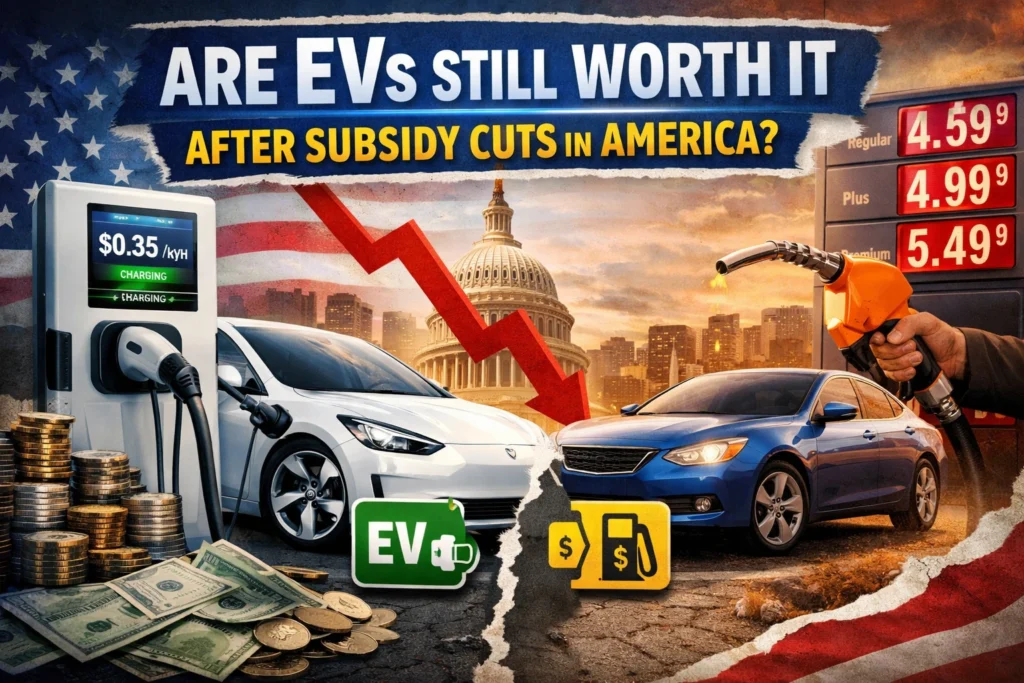
Imagine you’ve been eyeing a shiny new electric SUV for months. You’ve done the research, visited the dealership, maybe even test-driven it. Then, on July 4, 2025, Congress pulls the rug out — and just like that, the $7,500 federal EV tax credit is gone.
That’s exactly what happened when President Trump signed the One Big Beautiful Bill Act into law. The bill terminated both the $7,500 credit for new EVs and the $4,000 credit for used EVs, effective September 30, 2025. Credits that were supposed to run through 2032 vanished with little warning.
So now it’s 2026 — and American car buyers are left asking a very reasonable question: Are electric vehicles still worth it?
The short answer? For many drivers, yes — but with important caveats. In this ultimate guide, we break down the real numbers, reveal what incentives still exist, and give you a proven framework for making the right call. Whether you’re in California, Texas, or Ohio, this article covers everything you need to know about buying an EV after the federal subsidy cuts.
What Changed: The Subsidy Cuts Explained
To understand whether an EV is worth buying now, you first need to understand what was cut and why it matters.
The One Big Beautiful Bill Act (OBBBA)
Signed on July 4, 2025, the OBBBA restructured dozens of energy and vehicle-related tax policies. For EV buyers, the key changes were:
- Section 30D (New EV Credit): The $7,500 new clean vehicle tax credit ended September 30, 2025. No phase-out — a hard stop.
- Section 25E (Used EV Credit): The $4,000 used EV credit (or 30% of sale price, whichever was lower) also ended September 30, 2025.
- Section 45W (Commercial/Lease Credit): The commercial credit that dealers used to discount EV leases also expired on the same date.
- Section 30C (Home Charger Credit): A 30% credit (up to $1,000) for home EV charger installation remains available through June 30, 2026 — but only for buyers in low-income or rural census tracts.
Why Were the Credits Cut?
The credits were controversial from the start. Critics argued they disproportionately benefited higher-income households who could afford EVs in the first place, while ordinary taxpayers footed the bill. By 2024, as EV sales growth slowed despite the ongoing credits, questions grew about whether the program was actually moving the needle on adoption.
Supporters countered that the credits were working exactly as intended — helping build consumer confidence and industry infrastructure during a critical growth phase. Germany offers a cautionary tale: when it ended similar subsidies, battery-electric vehicle sales fell from 18.5% of new registrations in 2023 to 13.5% in 2024.
“The end of the federal EV tax credits is like the training wheels being taken off of a nascent technology. Those training wheels helped balance and support EV adoption.” — Industry analyst quoted by CNBC, July 2025
Total Cost of Ownership: The Real Math in 2026
Here’s the truth that most headlines miss: the sticker price is only one piece of the puzzle. Total cost of ownership (TCO) includes purchase price, fuel, maintenance, insurance, and depreciation over the life of the vehicle. And when you run those numbers, EVs often still come out ahead.
The Upfront Cost Gap
According to Kelley Blue Book, the average new EV cost $57,245 as of August 2025, compared to $49,077 for all new vehicles. Without the $7,500 credit, that gap widens considerably — a 13% premium that’s now entirely out-of-pocket for most buyers.
Fuel Savings: Where EVs Win Big
This is where electric vehicles make back their premium — and then some. The average American driver travels roughly 15,000 miles per year. Here’s how the annual fuel costs compare:
| Vehicle Type | Annual Fuel Cost | Cost per Mile | 5-Year Fuel Total |
|---|---|---|---|
| EV (home charging) | ~$675 | ~$0.045 | ~$3,375 |
| Gas car (avg. 30 MPG) | ~$2,220 | ~$0.148 | ~$11,100 |
| Hybrid (avg. 48 MPG) | ~$1,387 | ~$0.092 | ~$6,935 |
Estimates based on national average gas price of $3.50/gal and electricity at $0.14/kWh (U.S. EIA averages). Actual savings vary by location and driving habits.
Maintenance: The Silent Savings
EVs have far fewer moving parts than internal combustion engines. No oil changes, no spark plugs, no exhaust system. Over a 10-year ownership period, EV owners typically save $2,000–$4,000 on maintenance versus a comparable gas vehicle.
- EV with federal tax credit: Lowest total cost
- EV without federal tax credit: Second-lowest total cost
- Gas vehicle: Most expensive to own overall
The International Council on Clean Transportation (ICCT) reached similar conclusions — projecting that EV owners with up to 300 miles of range would save $6,600–$11,000 in fuel and maintenance alone over a 6-year ownership period, without any tax credits factored in.
Key Benefits of Owning an EV in 2026
Beyond the dollars-and-cents argument, there are compelling practical reasons to go electric — reasons that no subsidy cut can change.
EV Advantages
- Lower long-term fuel costs
- Dramatically cheaper maintenance
- Home charging convenience — fuel up overnight
- Smooth, quiet, responsive driving experience
- Reduced tailpipe emissions
- HOV lane access in many states
- State and utility incentives still available
- Battery tech improving every year
EV Disadvantages
- Higher upfront purchase price
- No federal tax credit post-Oct 2025
- Charging infrastructure still patchy in rural areas
- Faster depreciation than gas vehicles
- Higher insurance premiums
- Range anxiety for long-distance driving
- Battery replacement cost risk (out of warranty)
Step-by-Step Guide: How to Decide If an EV Is Right for You
Not every driver’s situation is the same. Use this proven decision framework to figure out whether buying an EV makes financial and practical sense for your life.
-
Calculate your annual mileageEV economics work best for high-mileage drivers. If you drive 12,000+ miles per year, fuel savings accumulate fast. If you drive fewer than 8,000 miles annually, the math becomes tighter without the tax credit. Use the U.S. Department of Energy’s free Fuel Economy Calculator to model your specific numbers.
-
Assess your charging situationHome charging is the single biggest factor in EV economics. If you own your home and can install a Level 2 charger (typically $500–$1,500), you’ll charge for roughly $0.04–0.06/mile — far cheaper than gas. If you rely entirely on public fast-charging, costs rise significantly and the savings narrow.
-
Research state and utility incentivesFederal credits are gone, but state programs are alive and well. California offers rebates up to $7,500 for qualifying buyers. Colorado offers a state tax credit of up to $5,000. New York offers $2,000 through its Drive Clean Rebate. Your electric utility may offer an additional $200–$2,500. Stack these programs and you can recover thousands even without Washington’s help.
-
Compare total cost of ownership, not sticker priceUse Edmunds’ True Cost to Own tool or Plug In America’s TCO calculator to model the 5–7 year ownership cost of the EVs you’re considering versus their gas equivalents. This single step can completely change your decision.
-
Consider manufacturer incentives and lease dealsMany automakers — including GM, Ford, and Hyundai — have announced their own $7,500 price reductions to help compensate for the lost federal credit. Others offer 0% financing or attractive lease terms. Leasing, in particular, remains an excellent option for many buyers because it limits your exposure to depreciation risk.
-
Evaluate long-term plans and flexibilityAre you planning to keep the car for 7+ years? Great — longer ownership periods amplify EV savings. Selling in 2–3 years? Be cautious — EV depreciation rates are currently higher than for gas vehicles, partly because the technology evolves so quickly.
Alternative Incentives Still Available in 2026
The federal government isn’t the only game in town. In 2026, savvy buyers can still unlock significant savings by stacking multiple incentive sources.
State-Level EV Rebates and Tax Credits
| State | Max Incentive | Type | Income Limits? |
|---|---|---|---|
| California | $7,500–$12,000 | Rebate | Yes |
| Colorado | $5,000 | State Tax Credit | No |
| New York | $2,000 | Point-of-Sale Rebate | Yes |
| Oregon | $2,500+ | Rebate | Yes |
| New Jersey | $4,000 | Sales Tax Exemption + Rebate | No |
| Maryland | $3,000 | Excise Tax Credit | No |
State programs change frequently. Always verify current availability at your state energy office website before purchase.
Utility Company Rebates
This is one of the most overlooked savings opportunities. Many electric utilities — including major providers like Pacific Gas & Electric, Xcel Energy, and Duke Energy — offer rebates of $200–$2,500 for purchasing or leasing an EV. Some also offer reduced electricity rates for off-peak EV charging. A single phone call to your utility could save you real money.
The New Car Loan Interest Deduction
One positive change tucked into the OBBBA: starting in 2025, buyers who finance a new personal-use vehicle can deduct up to $10,000 per year in loan interest on their federal taxes. This applies to EVs, hybrids, and gas vehicles, and is available through 2028. For buyers financing $40,000+ at current rates, this could mean $1,000–$2,000 in annual tax savings.
Common Mistakes to Avoid When Buying an EV Now
The post-subsidy landscape is new territory for most buyers. Here are the biggest pitfalls — and how to sidestep them.
Mistake #1: Comparing only sticker prices
Why it’s a problem: An EV that costs $8,000 more upfront might save you $15,000 over 7 years. Fix: Always run a 5–7 year TCO comparison using actual numbers for fuel and maintenance.
Mistake #2: Ignoring depreciation
Why it’s a problem: EVs currently depreciate faster than comparable gas vehicles, partly because EV technology evolves rapidly. This can significantly impact total ownership cost, especially for short-term owners. Fix: Plan to keep your EV for at least 5–7 years to maximize savings, or consider leasing to avoid depreciation risk.
Mistake #3: Skipping state and utility incentive research
Why it’s a problem: Many buyers assume there are no incentives left and overpay. Fix: Before signing anything, check your state energy office and call your utility company. You could be leaving thousands of dollars on the table.
Mistake #4: Overlooking home charging requirements
Why it’s a problem: Without home charging, EV economics shift dramatically. Public Level 3 fast-charging can cost 2–3× more per mile than home charging. Fix: If you live in an apartment or condo, factor in the realistic cost of public charging before purchasing.
Mistake #5: Assuming all EVs are created equal
Why it’s a problem: There’s enormous variation in range, charging speed, reliability, and resale value across EV models. Fix: Research specific models using Consumer Reports reliability ratings and Edmunds’ True Cost to Own before committing.
Expert Tips and Best Practices for Smart EV Buying in 2026
These advanced strategies can give you a real edge in today’s market.
Consider a lease over a purchase
Leasing sidesteps the depreciation risk entirely and typically offers attractive monthly payments. Many automakers are currently offering aggressive lease deals to compensate for the lost federal credit. A well-structured lease can deliver excellent value even in today’s subsidy-free environment.
Explore the certified pre-owned EV market
Used EVs are a hidden gem right now. Many well-maintained off-lease EVs are hitting the market with remaining battery warranties and significantly lower asking prices than new models. As Ingrid Malmgren of Plug In America told CNBC: “There are a ton of great deals on used EVs. If I were shopping for a vehicle right now, that’s what I’d be looking at.”
Time your purchase strategically
End-of-quarter and end-of-year periods typically see dealers offering their best incentives to hit sales targets. December 2026, for example, could be an excellent time to negotiate, as dealers will be motivated to move inventory.
Leverage manufacturer direct incentives
Several major automakers — including GM, Ford, Hyundai, and Kia — have pledged to offer their own $7,500 price reductions on select models to maintain sales momentum after the federal credit’s expiration. Ask your dealer directly what manufacturer support is available on the specific model you’re considering.
Invest in home solar to maximize savings
Combining an EV with rooftop solar panels takes energy savings to the next level. When you fuel your car with solar electricity, your effective per-mile fuel cost can approach near-zero. Many states still offer generous solar incentives that can offset the installation cost.
EV vs. Gas vs. Hybrid: Side-by-Side Comparison (2026)
Still not sure which direction to go? This at-a-glance comparison breaks down the key decision factors for each powertrain type for the typical American buyer in 2026.
| Factor | Electric (BEV) | Plug-in Hybrid (PHEV) | Traditional Gas |
|---|---|---|---|
| Avg. Upfront Cost | $$$$ (~$57K) | $$$ (~$47K) | $$ (~$49K) |
| Federal Incentive | None | None (as of Oct ’25) | None |
| Annual Fuel Cost | ~$675 | ~$1,100 | ~$2,200 |
| Annual Maintenance | Lowest | Moderate | Highest |
| Home Charging Needed? | Strongly recommended | Optional but helpful | No |
| Range Anxiety Risk | Moderate | None | None |
| Long-Term Savings (7 yr) | $6K–$12K | $2K–$5K | Baseline |
| Best For | High-mileage commuters with home charging | Drivers who want flexibility | Rural drivers, frequent long-haul |
🔗 Related Reading
Conclusion: The Honest Answer for American EV Buyers
The loss of the $7,500 federal EV tax credit is real, significant, and changes the math for a lot of buyers. There’s no point sugarcoating it.
But here’s what hasn’t changed: EVs still have fundamentally lower operating costs than gas cars. Fuel is cheaper. Maintenance is simpler. The technology keeps improving and prices are projected to reach parity with gas vehicles by 2028–2029.
For the right buyer — someone who drives 12,000+ miles per year, has access to home charging, plans to keep the car for at least 5–7 years, and lives in a state with active incentive programs — the electric vehicle still makes excellent financial sense in 2026.
For buyers without home charging, with shorter ownership horizons, or in areas with poor charging infrastructure, a plug-in hybrid might be the smarter bridge to an all-electric future.
The key is doing your homework. Run the total cost of ownership numbers. Research your state’s incentives. Ask dealers about manufacturer discounts. And remember — the federal government may be out of the picture, but the financial case for EVs is driven by physics (cheaper electricity vs. gasoline) and engineering (fewer parts to break), and neither of those is going anywhere.
Ready to take the next step? Use the resources below, share this article with a friend who’s on the fence, and drop your questions in the comments. The EV market is evolving fast — and the best-informed buyers will always come out ahead.
Was This Guide Helpful?
Share it with someone who’s considering an EV purchase — and subscribe for the latest updates on EV incentives, model releases, and money-saving tips for American drivers.
Frequently Asked Questions
Quick answers to the top questions American buyers are asking about EVs in 2026.
Is there still a federal EV tax credit available in 2026?
No. The $7,500 federal new EV tax credit and the $4,000 used EV credit were both terminated on September 30, 2025, under the One Big Beautiful Bill Act. The only remaining federal EV-related incentive is a limited home charger credit (30%, up to $1,000), available only in qualifying census tracts through June 30, 2026.
Are EVs still cheaper to own than gas cars without the federal tax credit?
For most high-mileage drivers with home charging, yes. Studies by Plug In America and the ICCT show EVs save $6,600–$12,000 in fuel and maintenance over 6–10 years — even without any tax credits. The savings depend heavily on annual mileage, local electricity rates, and whether you can charge at home.
What state EV incentives are available in 2026?
Many states still offer strong incentives. California offers up to $12,000 for low-income buyers. Colorado has a $5,000 state tax credit. New York offers $2,000 through the Drive Clean Rebate. Oregon, New Jersey, and Maryland also have active programs. Check your state energy office for the most current information, as programs change frequently.
Should I buy or lease an electric vehicle in 2026?
Leasing is especially attractive in 2026 because it eliminates depreciation risk, often comes with lower monthly payments, and allows you to upgrade to newer technology in 2–3 years. Many automakers are offering aggressive lease deals to compensate for the lost federal credit. Buying is better if you plan to keep the car 7+ years and want to maximize lifetime savings.
How much does it cost to charge an EV at home vs. a public charging station?
Home charging on a Level 2 charger typically costs $0.04–0.06 per mile at average U.S. electricity rates — roughly 3–4× cheaper than gasoline. Public Level 3 DC fast charging typically costs $0.20–0.35 per kWh (or per minute), which can be 2–3× more expensive than home charging and narrows the cost advantage over gas vehicles significantly.
Which electric vehicles offer the best value in 2026 without the federal credit?
Models with strong value propositions in 2026 include the Chevrolet Equinox EV (competitive base price), Tesla Model Y (strong resale value and charging network), Hyundai Ioniq 6 (exceptional efficiency), and the Ford Mustang Mach-E (manufacturer incentives available). Always compare Total Cost of Ownership for your specific situation rather than relying on MSRP alone.
When will EV prices reach parity with gas car prices?
The ICCT projects EV purchase price parity with comparable gas vehicles around 2028–2029. Battery costs have fallen 87% since 2010, and continued improvements in manufacturing, battery chemistry, and scale are expected to close the remaining price gap within this decade, even without federal subsidies.